The Future Of Luxury
Challenge
Luxury retail is radically changing. A new generation of consumers are reshaping expectations around experience, value, culture and technology, challenging long-established models of brand engagement.
For Capri Holdings and Michael Kors, this moment raised a critical leadership question: how do you anticipate and lead change in a market where consumer behaviour, cultural relevance and retail formats are evolving simultaneously?
The EMEA leadership team needed a clear, future-focused perspective that moved beyond trend observation and into strategic implication; one that could inspire senior decision-makers, aligning the organisation around emerging opportunities and opening up new thinking about growth.
As younger luxury consumers continue to rewrite the industry rulebook, Michael Kors needed to know how to embrace these shifts and move forward, leading the way.

Our Role:
We were invited to open the Michael Kors EMEA leadership team in Athens with a keynote on the Future of Luxury Retail.
Our role was to translate global shifts in consumer behaviour, technology and culture into a clear strategic narrative for the leadership team; moving the conversation from what is changing to what it means for the business.
Drawing on primary research conducted in China and Japan, alongside behavioural analysis and global retail insight, we developed a futures-led framework that identified the transitions most likely to reshape luxury retail in the years ahead.
This created a shared lens through which leaders could evaluate emerging opportunities, challenge existing assumptions and reframe their approach to customer engagement.
Our Approach
We began by exploring the markets where the future of luxury is already taking shape. Our research in China and Japan provided a live view of next-generation retail behaviours, from new models of experiential consumption to the integration of digital ecosystems into physical environments.
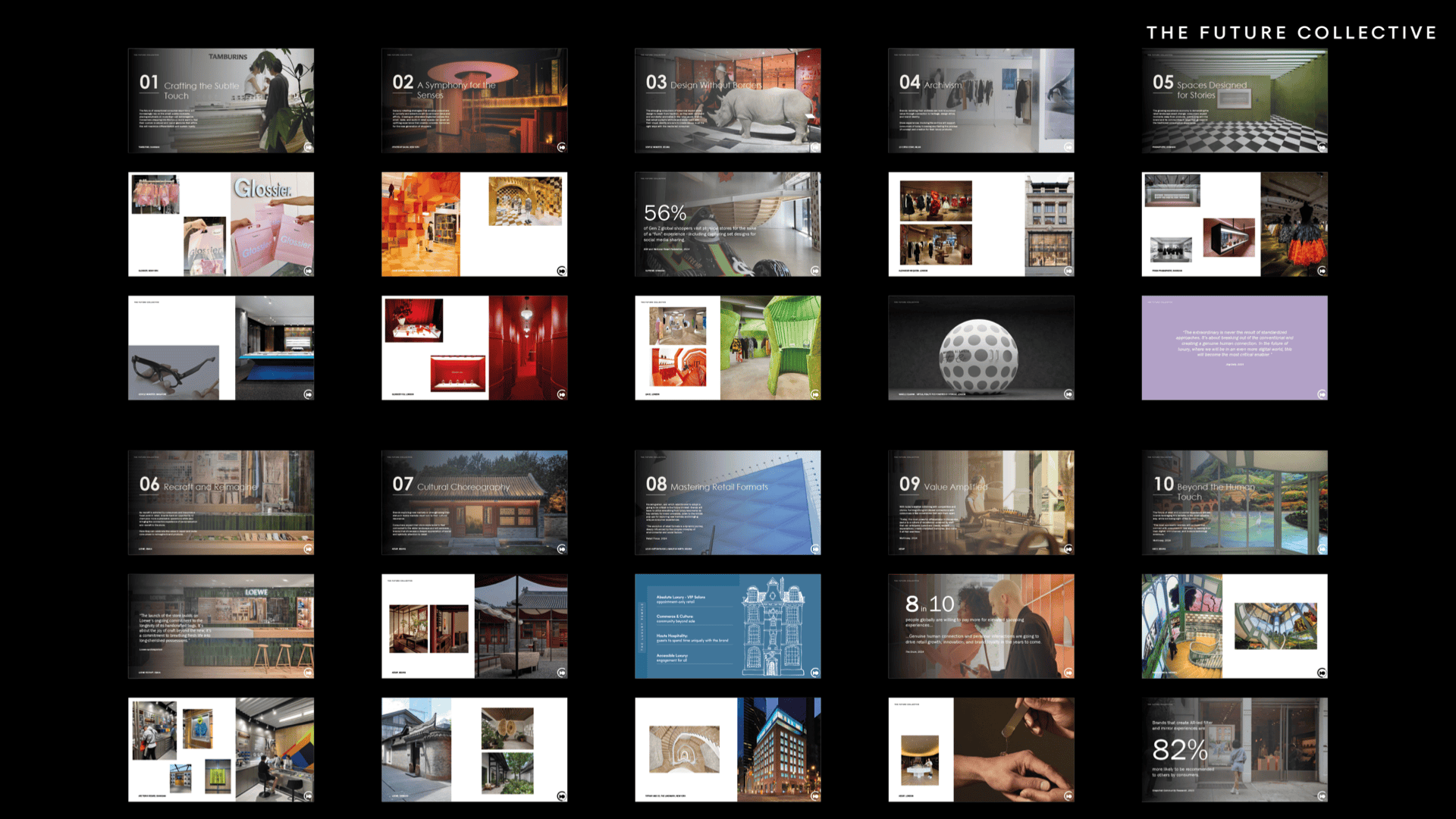
From this foundation, we identified ten critical retail transitions that are redefining how luxury brands create value and build relevance. Rather than presenting these as abstract trends, we anchored each shift in real-world early adopters, translating insight into tangible strategic possibility.



We highlighted key themes across experiential retailing, consumer wellbeing, socio-cultural understanding and technological adoption to carve out new ways of thinking.
Visual frameworks and behavioural evidence were used throughout to make complex change clear, actionable and commercially relevant for a senior audience.
Impact:
This work reframed the leadership conversation from reacting to market change to actively shaping it.
The EMEA team left with a clearer understanding of the structural forces redefining luxury retail and a set of tangible growth opportunities grounded in real consumer behaviour.
By connecting global insight to brand-specific implication, the session created both inspiration and strategic direction, equipping leaders with a common language to guide future engagement strategies.
In a sector where relevance is defined by the ability to anticipate cultural and behavioural shifts, this work positioned the business to move forward with greater intent.