
Paving the Way for the Future
Challenge
Since the 1890s, Marshalls plc has helped shape the UK’s built environment, supplying hard landscaping, building and roofing solutions to projects ranging from domestic gardens to national infrastructure.
But the context in which the built environment operates is shifting. Sustainability expectations are rising and climate resilience is moving from aspiration to requirement. Urban density, biodiversity, regulation and material innovation are redefining what “good” looks like in both public and private space.
For Marshalls, the question was how to lead this change.
The business needed a structured, future-facing innovation roadmap; one that could inform short, medium and long-term product development, anticipate emerging customer needs and ensure that commercial decisions taken today would remain relevant in a decade’s time.
Our Role
We partnered with Marshalls to build a strategic foresight programme designed to guide innovation across multiple horizons. Our role was to translate macro-level shifts, from environmental policy and material science to behavioural change and urban design, into clear product and portfolio implications.
Through a series of trend and insight reports, we created a structured innovation lens to support decision-making across R&D, design and commercial teams. This work connected incremental product evolution with more transformative, long-term opportunity spaces.
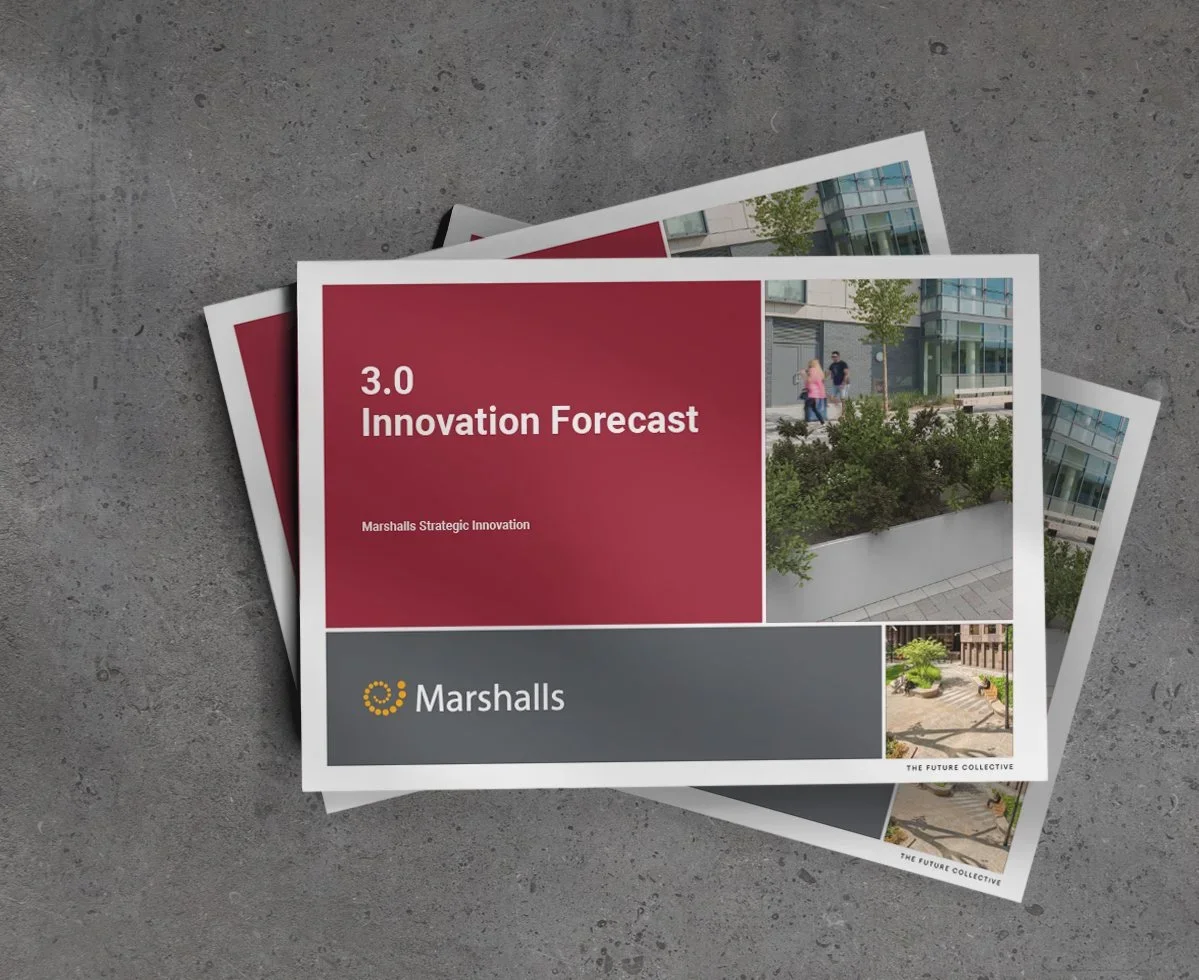
Alongside internal strategy development, we distilled our thinking into a bespoke external-facing report, positioning Marshalls as a forward-thinking and visionary authority within the built environment sector.
Our Approach
We began by mapping the structural forces reshaping the built environment over the next decade. These included climate adaptation, sustainable material innovation, evolving planning frameworks, changing patterns of home ownership and new expectations around public space design.
Our insight was structured into a connected system of change, allowing Marshalls to see where forces converge and where new opportunity areas emerge; from permeable surfaces and circular material strategies to modular design and nature-integrated spaces.
Each horizon was clearly defined:
Short-term: Enhancing and adapting existing ranges in response to immediate regulatory, environmental and customer pressures.
Medium-term: Expanding into adjacent solution areas shaped by evolving lifestyle and urban needs.
Long-term: Reimagining the role of materials and surfaces within climate-resilient, biodiverse and digitally enabled environments.
This framework created clarity across innovation planning, ensuring that product development is both commercially grounded and strategically ambitious.

Impact
This programme has equipped Marshalls with a scalable, long-term innovation lens.
By aligning macro foresight with product strategy, the business can balance immediate commercial opportunity with future resilience. The report further strengthens Marshalls’ market positioning, demonstrating leadership beyond product capability and reinforcing its role as a shaper of the UK’s future built environment.
With a clearer view of what lies ahead, Marshalls is able to design for the spaces, standards and expectations of tomorrow.